
Molecular Glue:
Novel Modalities Engineered for
Oncology's Toughest
Challenges
How Lilly's first-in-class polymerizing molecular glue differs from other protein degraders1,2
Addressing “undruggable” targets with targeted protein degradation
Transcription factors, such as BCL6, can be difficult to target because their complex structures lack well-defined small-molecule binding pockets. Classical inhibitors often fail to engage them effectively.3,4 Targeted protein degradation (TPD) bypasses this challenge by harnessing the cell's own ubiquitin–proteasome system (UPS) to eliminate disease-driving proteins entirely, rather than merely inhibiting their activity. In addition, a single degrader can destroy many copies of a pathogenic protein, providing greater efficiency at very small doses.5
Lilly’s first-in-class molecular glue1,2,6,7
Lilly’s first-in-class molecular glue drives self-association of BCL6 dimers, forming higher-order BCL6 polymers. These are recognized and ubiquitinated by a broad range of E3 ligases and degraded by the proteasome—a mechanism distinct from both traditional molecular glues and conventional PROTACs.

See Lilly’s first-in-class molecular glue in action1,2
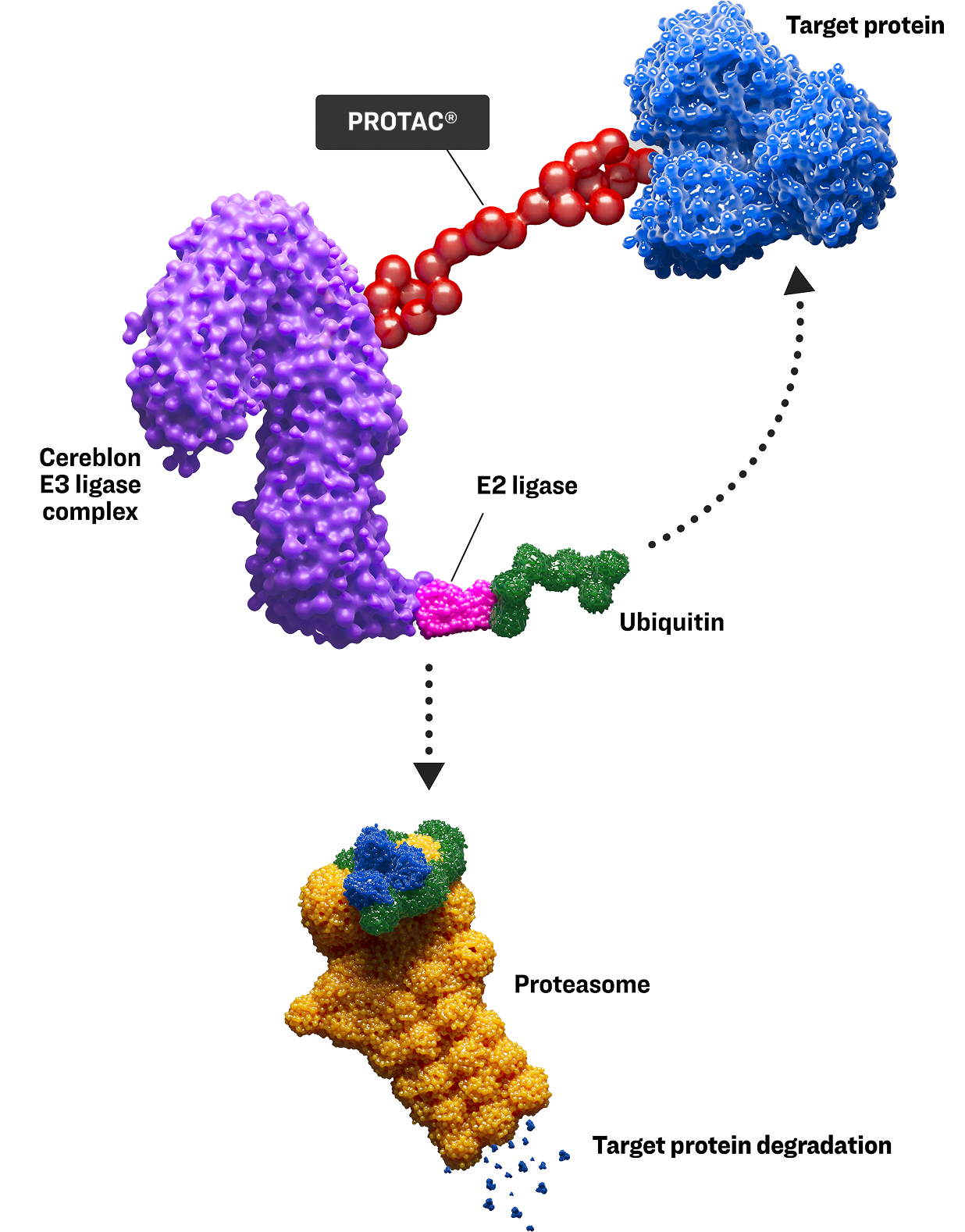
PROTACs/ligand directed degraders4-6,8
A PROTAC or ligand directed degrader (LDD) is a bivalent molecule with two binding ends connected by a chemical linker. One end binds the target protein and the other binds cereblon (CRBN), a substrate receptor of the E3 ubiquitin ligase complex.
By physically bridging the two proteins, the PROTAC forces proximity between the target and cereblon, inducing cereblon-mediated ubiquitination of the target protein—tagging it for destruction. The tagged protein is then recognized and degraded by the proteasome.
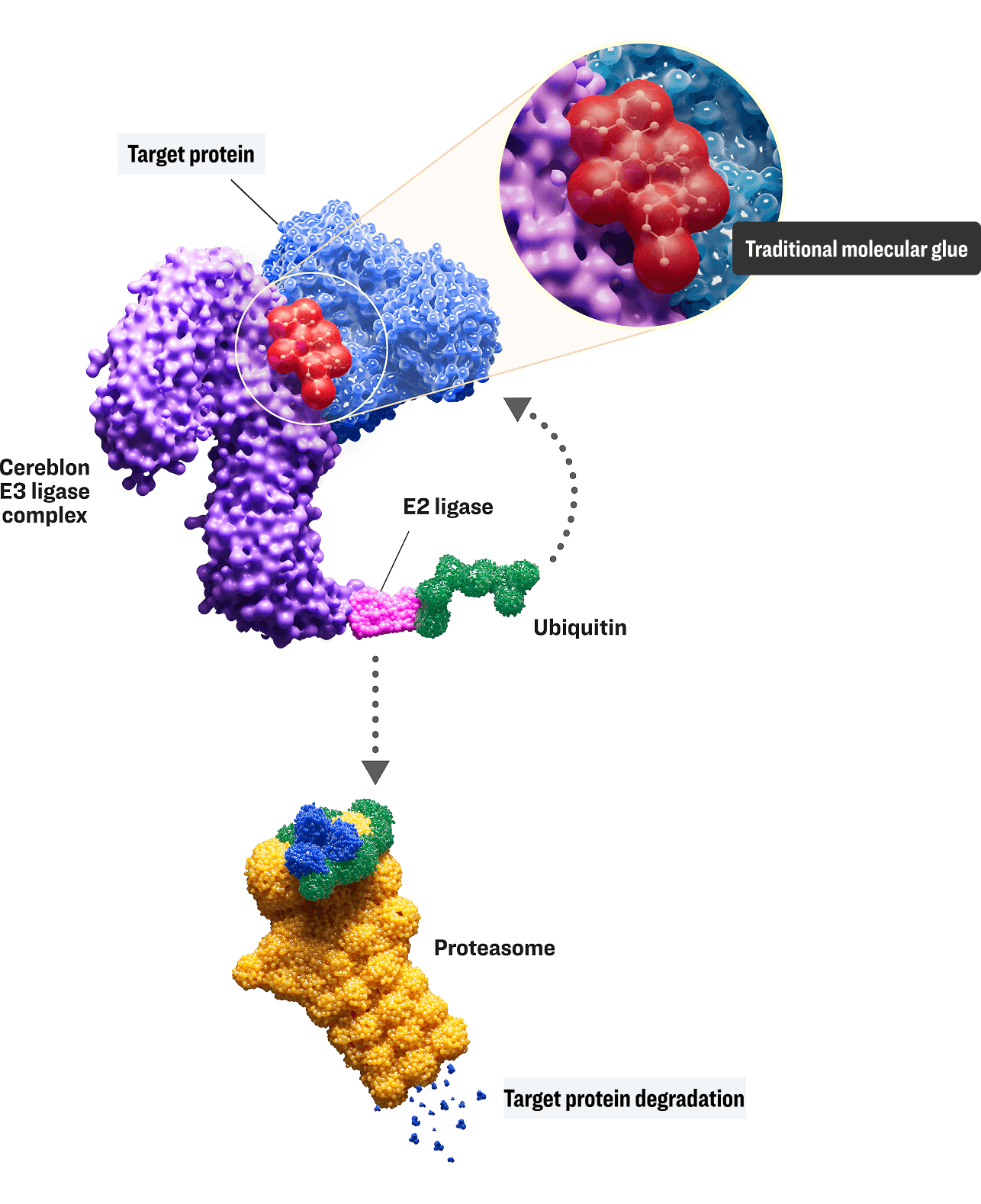
Traditional molecular glue degraders4-6
Traditional molecular glues like immunomodulatory imide drugs (IMiDs) (eg, thalidomide, lenalidomide, pomalidomide) work by binding cereblon and reshaping its surface to create a neo-interface that recruits neosubstrates—proteins cereblon would never normally recognize. The molecular glue degrader stabilizes this protein–protein interaction, allowing cereblon to ubiquitinate the neosubstrate (eg, Ikaros, Aiolos), inducing proteasomal degradation.
Unlike PROTACs, the molecular glue degrader doesn't bind the target protein independently—it works entirely through conformational remodeling of cereblon.
How Lilly’s molecular glue differs2,4-6,9,10
Lilly’s molecular glue is a monovalent small molecule that differs fundamentally from bivalent degraders (PROTACs/LDDs) and traditional molecular glue degraders (IMiDs) in design and mechanism of action:
| Feature | Lilly’s Molecular Glue (Monovalent) | PROTAC/LDD (Bivalent) | Traditional Molecular Glue Degraders (IMiDs) |
|---|---|---|---|
| Structure | Linker-free; monovalent small molecule | Bivalent with chemical linker | Linker-free; monovalent small molecule |
| Mol. Weight | ~500 Da | ~700-1,000 Da | <500 Da |
| Binding | Induces/stabilizes novel target protein interactions to form polymers | Requires high-affinity binding sites on both cereblon E3 ligase & target protein | Requires binding of cereblon, reshaping its surface to create a neo-interface that recruits neosubstrates (target protein) |
| E3 Ligase Use | Multiple E3 ligases recognize the polymers—not limited to cereblon | Cereblon-dependent | Cereblon-dependent |
| Risk of Ligase Resistance | Broad E3 ligase utilization reduces single ligase dependency | Cereblon loss-of-function mutations confer resistance | Cereblon loss-of-function mutations confer resistance |
References: 1. Slabicki M, et al. Nature. 2020;588(7836):164-168. 2. Langan CJ, et al. LY4584180, a novel BCL6 molecular glue, demonstrates antitumor efficacy in preclinical models of B-cell NHL. Poster presented at: AACR 117th Annual Meeting; April 17-22, 2026; San Diego, CA. Poster 4594. 3. Cerchietti LC, et al. Cancer Cell. 2010;17(4):400-411. 4. Henley MJ, Koehler AN. Nat Rev Drug Discov. 2021;20(9):669-688. 5. Sasso JM, et al. Biochemistry. 2023;62(3):601-623. 6. Domostegui A, et al. Chem Soc Rev. 2022;51(13):5498-5517. 7. Béguelin W, et al. Cancer Cell. 2016;30(2):197-213. 8. Churcher I. J Med Chem. 2018;61(2):444-452. 9. Cieślak M, Słowianek M. Pharmaceutics. 2023;15(3):812. 10. Zhu YX, et al. Blood. 2011;118(18):4771-4779.
BCL6=B-Cell Lymphoma 6; PROTAC=Proteolysis Targeting Chimera.
or visit www.clinicaltrials.gov for more information on this trial
This website was commissioned by Lilly Medical and is indicated to be used by HCPs for medical, scientific, and educational purposes.
The safety and efficacy of the agents for uses under investigation have not been established. Pipeline molecules may not receive regulatory approval and become commercially available for the uses being investigated. The information provided about new molecules being studied is for scientific information exchange purposes only with no commercial intent.